A New Category of Intervention

Your decisions aren't wrong.
Your architecture is.

MythoGenX delivers precise intervention for leaders whose decision-making structures have become misaligned with the reality they're operating in. Not coaching. Not consulting. Structural correction via DecypherScan.

The decisions that matter most are the ones that won't move

You've built the career. You have the information. You understand the stakes. And yet certain decisions remain stuck, not because of missing data or unclear options, but because the architecture organizing how you perceive, interpret, and act has drifted out of alignment with the conditions you're actually navigating.

Temporal Misalignment

Operating from a time horizon that doesn't match the actual timeline of consequence. Making long-term decisions with short-term perception, or vice versa.

Spatial Misalignment

Scoping decisions too narrowly or too broadly for the actual domain of impact. Missing the boundaries where your decisions actually take effect.

Consequential Misalignment

Reading the weight and reach of outcomes through a distorted lens. The architecture tells you this is low-stakes when it's high, or urgent when it's not.

Foundational Model

The Scope of Decision
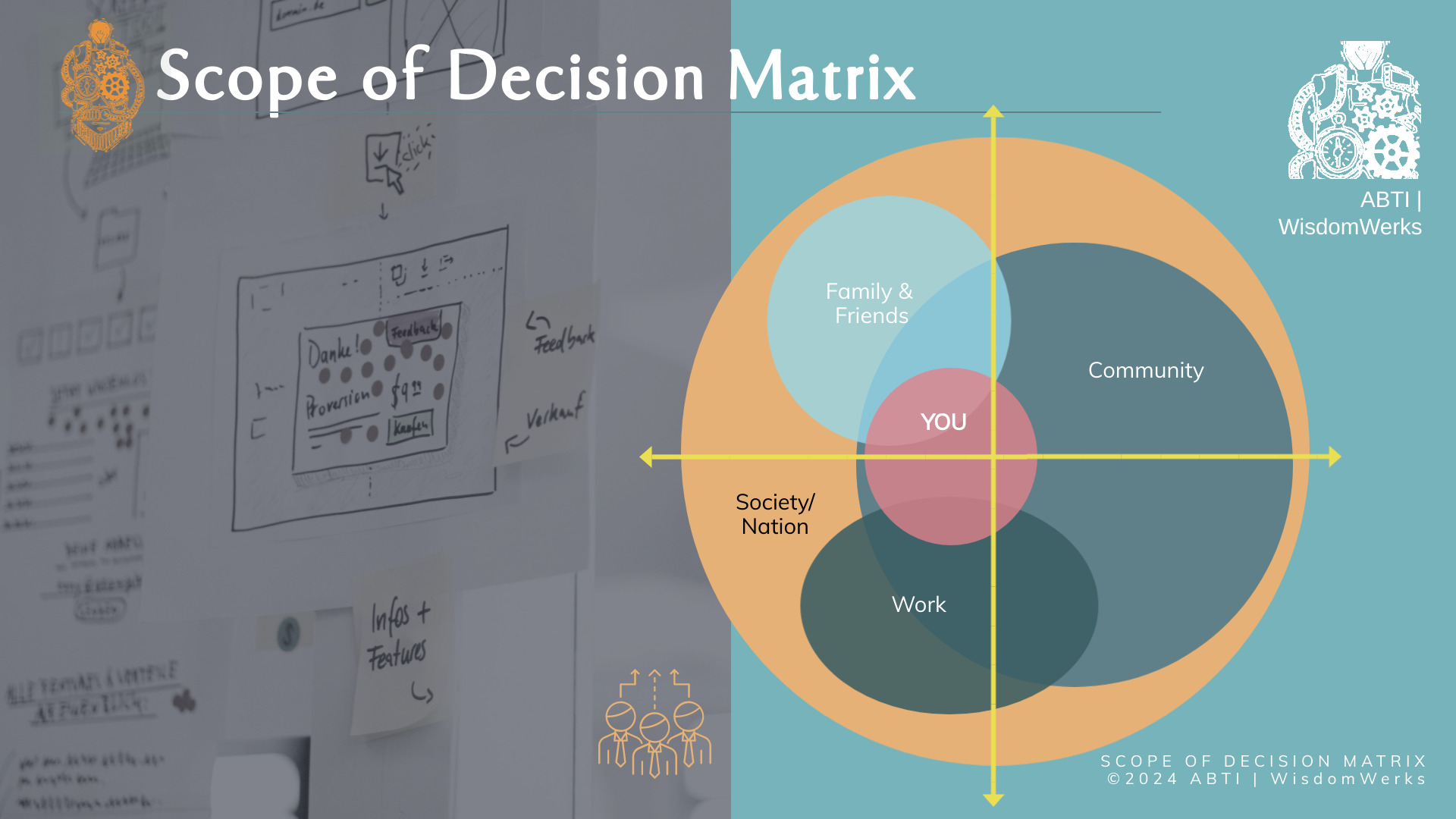
Scope of Decision Matrix

The Scope of Decision is the essential model — alongside the OLAM model — that defines and grounds the entire MythoGenX ecosystem. It maps the relational geometry of every decision: the domains across which decisions operate and compound.

  • YOU The center. The decision-maker.
  • Family & Friends The immediate relational field.
  • Work Professional domain and organizational context.
  • Community The broader network of relationships and obligations.
  • Society / Nation The widest consequential field.

Every decision carries temporal reach, spatial field, and consequence structure across these domains. Decision collapse occurs when the scope is misproportioned — when the architecture organizing the decision doesn't match the actual relational geometry the decision operates within.

The Architecture

Five layers organize every decision you make

Before these five layers can be addressed, the architecture they run on has to be corrected. That's what DAC does — it operates at the pre-conscious, pre-representational foundation that precedes all of this. Each of these layers becomes visible and correctable only after that foundation has been recalibrated. Without it, they're running on a misaligned base. Adjusting them directly doesn't reach the mechanism.

Ladder of Perception
01
Perception

What you notice. What you filter out. The raw input layer that shapes everything downstream.

02
Sense-Making

How you organize what you perceive into coherent patterns. The structure you impose on complexity.

03
Meaning-Making

The significance you assign. Where stakes, value, and importance get calibrated or miscalibrated.

04
Decision-Making

The choice itself. By this layer, the decision is already shaped by everything above it.

05
Action-Taking

Execution. Where architectural misalignment shows up as hesitation, misfire, or paralysis.

The Distinction

This is not what you think it is

Executive Coaching

Changes behavior

Works at the habit level. Modifies what you do after the decision has already been shaped by your existing architecture. Surface-level adjustment.

Decision Consulting

Provides frameworks

Gives you better maps. Analytical tools, decision trees, scoring models. Assumes the navigator is calibrated correctly. Often, they are not.

MythoGenX | DecypherScan

Corrects the architecture

Works at the ontological layer, the structure from which perception, sense-making, meaning-making, and action-taking are organized. Corrects the navigator, not the map.

Built on 30 years of proprietary methodology.
Backed by a PhD in decision-making under uncertainty.
Delivered to Fortune 100 executives across 30+ countries.

MythoGenX is the practice of Dr. Joseph Riggio, architect of the MythoSelf Process and the OLAM framework. DecypherScan is the diagnostic instrument. This is the most precise intervention available for leaders whose decisions have structural problems, not informational ones.